Scalar Towers – Vertical Listening with BJ Nilsen
At Anton Spice’s Substack
Vertical listening with BJ Nilsen
How does sound move differently in vertical space and what happens when we begin to think about architecture, landscape and the embedded histories they contain, in less horizontal terms?
“I find value in allowing sound to remain itself,” says Swedish composer and sound artist BJ Nilsen. Interested in the productive tension between recording and perception, Nilsen’s work stretches back three decades. He has collaborated with Chris Watson, Jóhann Jóhannsson, choreographer Örjan Andersson, and visual artist Femke Herregraven, released solo work on Editions Mego and Ideologic Organ, and spanned disciplines and environments to explore the layered ways in which we listen to the world around us. Rather than offer concrete perspectives, his work encourages a kind of creative ambiguity that, he says, “allows the listener to engage more freely, letting perception and imagination shape the meaning of the sound.
And yet, Nilsen’s work is not without specificity. For his latest project Scalar Towers, Nilsen visited two locations in the Netherlands, where he is now based, to ground his work – the water tower at 20th century communications complex Radio Kootwijk, and a former feed silo at the cultural site Het Lage Norden in the north of the country. Ground may be the wrong word. Pursuing an interest in the acoustics of vertical structures, Nilsen chose his sites for their height and the resonant qualities peculiar to narrow or tall spaces. Belltowers, lighthouses, cliffs and stairwells come to mind. In a sense it’s a simple premise – to explore how sound moves up and down a landscape, rather than across it – but not one I’d given much thought to.
Both sites had specific material qualities, as well as complex socio-cultural ones. Built in 1918, Radio Kootwijk facilitated long-distance communication between the Netherlands and what was then the Dutch East Indies, and although now decommissioned, remains a troubled monument to the colonial enterprise and the flows of control and information that underpinned it.
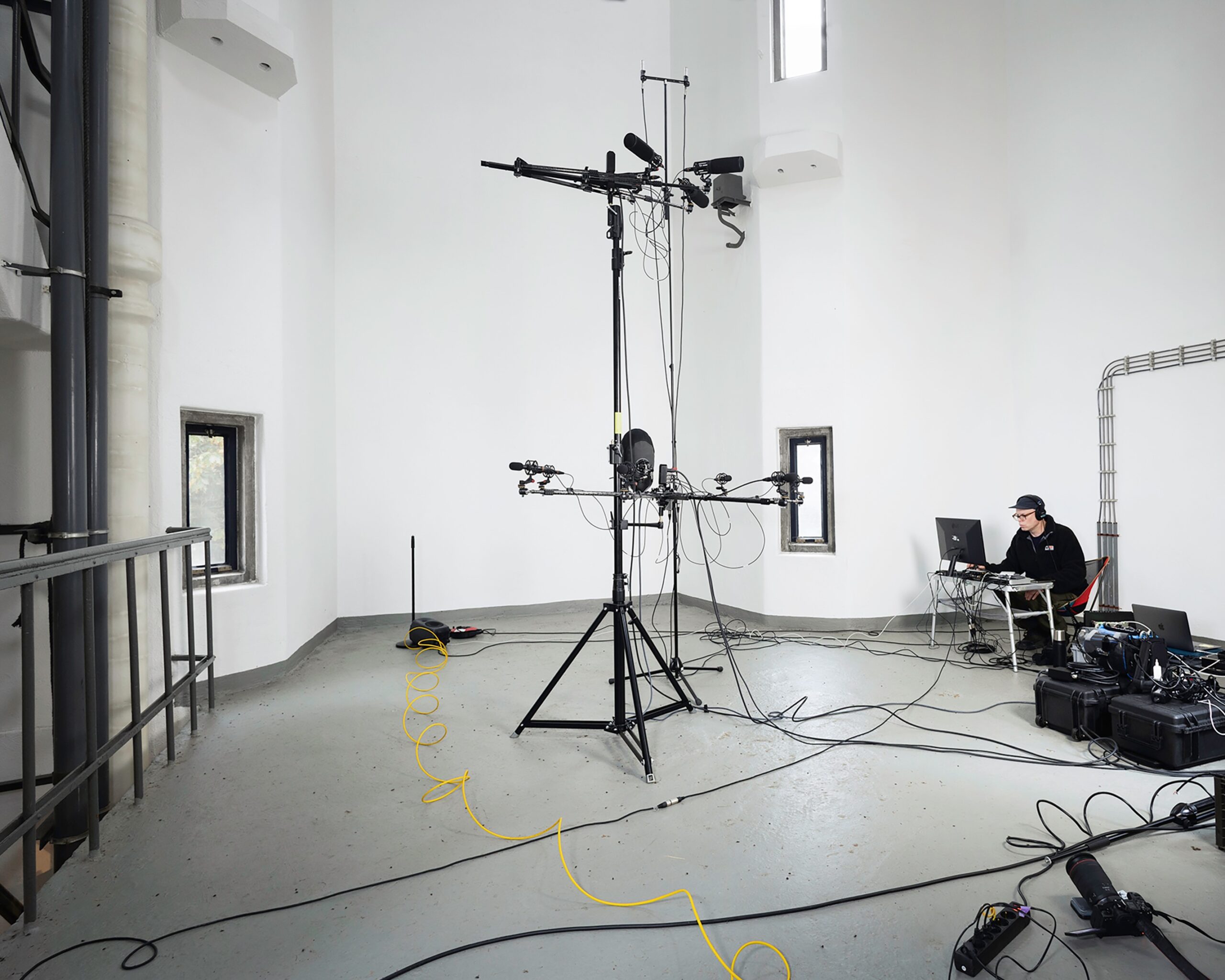
Taking part in the Sonic Acts Spatial Sound Residency in 2025, Nilsen used a custom-made vertical microphone array to capture recordings that were then worked up into compositions to be presented on the 60-speaker Acousmonium during the festival weekend of Sonic Acts Biennial in Amsterdam on Saturday 28th February. It was with Scalar Towers then, that we began our interview.
Tell me about the background to your new project Scalar Towers?
Scalar Towers began as an investigation into what happens when you think about sound vertically rather than horizontally. We’re used to imagining sound spreading out across a flat plane, but I became interested in what happens inside vertical structures — architectural shafts, towers, even geological formations — where sound doesn’t disperse evenly. Instead, it’s channeled. Horizontal movement is restricted, so reflections intensify along the vertical axis. You hear rapid returns, layered echoes, and you become acutely aware of what’s above and below you. The space starts to feel like a column of resonance.
With Scalar Towers, I wanted to explore how scale and elevation reorganise perception. Rather than presenting sound as a horizontal field, I approached it as something that accumulates, rises, or descends — something stratified. The concept of the work is really about shifting the listener’s orientation, from a lateral experience of space to a vertical one.
How did you approach the residency at Sonic Acts and what did you set out to explore?
For the residency at Sonic Acts, I wanted to work very directly with vertical architecture. I set out to explore how existing vertical structures could actively shape and transform sound — not just as sites for recording, but as resonant instruments in themselves.
I worked with an Atmos rig using twelve microphones designed by Danny van Lugt, which allowed me to capture sound spatially and with a strong sense of height. We brought the rig to two locations: an old water tower in Radio Kootwijk and a disused silo in Lage Noorden.
Rather than simply documenting these spaces, I played sounds from other vertical environments back into them and recorded how the architecture responded. The idea was to create a dialogue between vertical sites — to hear how one column of space would translate another, and how each structure would filter, stretch, and re-layer the material.
Why did you choose those sites specifically, and what were your first impressions when you visited? How did they sound?
They’re actually two very different kinds of vertical structures, and that contrast was important to me. The water tower in Radio Kootwijk is relatively closed and contained, so the acoustics feel concentrated and self-contained. The sound circulates internally — it builds up with a fast return, and creates a very focused column of resonance with a very clear and crisp long reverb trail. Like a huge bathroom.
The metal silo in Friesland, by contrast, is more open. Sound from the outside seeps into the structure, so the acoustic field feels more porous. You’re hearing not only the architecture itself, but also the surrounding environment filtering in. That permeability produces a very different spatial experience — less sealed, more contingent. We had quite some rain and wind which also played with the structure.
Those first impressions were very physical. One space felt overwhelmingly introspective and compressed; the other felt exposed and relational. That difference became leading to how I approached recording and composing with each site.
How did you approach the compositional aspect of this work?
The major challenge was how to translate the field recordings and complex acoustics into a meaningful composition — one that takes the character of the sites, their resonance, and the underlying concept into account. There’s always a delicate shift between the raw recording and the processed material: how much to preserve, how much to transform.
I was also attentive to the way external sounds bled into the structures, becoming part of the architecture’s voice. So the central question became: how do I compose with all of these parameters at once — site, scale, resonance, intrusion, and intention — without flattening their specificity?
In what ways can sound help us access or articulate the layers of history and narratives encoded in places like Radio Kootwijk, which are so implicated in Dutch colonialism?
Sound can help reveal the layers of history in places like Radio Kootwijk by thinking of sound as a kind of residue. Instead of telling history directly, I’m interested in how sound lingers in space and atmospheric traces that remain after human activity has passed. In that sense, listening becomes a way of sensing the past as something urgent but transformed. It can create a moment of reflection. I’m aware that a work might not spell everything out. Instead, it invites the listener to engage actively, using their senses and personal interpretation to fill in the gaps. The intention is to create a space where perception and reflection work together, rather than presenting a fully resolved or closed statement.
Can field recordings exist as sound objects independent of their sites, or will that context always make itself known?
Field recordings can function as sound objects in their own right, but I don’t think they are ever completely detached from their origin — there is usually a reason why they were recorded in the first place and will influence a composition. That said, I also believe that revealing too much about location or recording context can limit the listener’s imagination. Once everything is disclosed, part of the interpretive space is already filled.
How do you tread that line between context and experience for the listener?
I’m interested in working within that tension rather than resolving it. I’m not a purist when it comes to field recording. In Scalar Towers, I try to give enough context for the listener to have a starting point, a sense of site or atmosphere without fully fixing the meaning of the sound.
I value ambiguity because it allows listeners to bring their own associations and imagination. It’s about balancing contextual traces with keeping the sound open to interpretation. Artistically I need to engage with the material from a compositional perspective, it’s part of my process.
I am interested in the idea of vertical geography – thinking about the layers and elevations of landscapes and their political significance – but hadn’t thought much about this in sonic terms. What brought on your interest in verticality more broadly?
I also think about verticality in terms of layers. My interest began in mountains and vertical landscapes — in observing treelines, rock or snow lines, and other ecological thresholds that mark shifts in environment. Those visible strata made me aware that elevation creates distinct conditions. Over time, I began noticing that there are sonic thresholds as well — points where sound changes with height.
As you move upward, wind becomes more prominent, certain frequencies recede, and the density of forest or the openness of rock filters and reflects sound differently. The landscape operates as both a natural filter and resonant body. Vertical geography, then, is not only visible; it is audible.
Elevation influences who occupies certain spaces and whose voices are heard or muted. Sound can cross some boundaries while being shaped or blocked by others, making vertical space feel active rather than fixed. I’m interested in how these layered and political qualities can be experienced directly within a space.
In the mountains, you can feel both hidden and very audible — the terrain conceals you visually, but sound can carry clearly across distance. In the mountains everyone can hear you scream.
Perhaps a naïve question, but how does sound move in narrow vertical space? And how did you render or manipulate this back at the studio for spatial playback?
That’s not a naïve question at all. In vertical space, sound tends to be channelled rather than spread outward, reflections move primarily between surfaces above and below, creating rapid echoes and resonance build-up. This can produce a strong sense of height, where sound feels like it is rising, descending, or circulating In the studio, the goal wasn’t to reproduce the vertical space exactly, but to preserve the perceptual feeling of constrained vertical movement — the sense that sound is circulating upward and downward within a bounded structure. In the end I dropped a lot of microphone signals as they started to confuse the vertical sensation.
I’m going to borrow a question from the accompanying text to your 2025 album True Than Nature to end on: “What is the role of listening in understanding the world?” Have you found any answers to this through your own practice?
In my work, listening is a way of understanding the world that goes beyond information or representation. It allows me to experience environments as living, changing systems that is shaped by movement, material, atmosphere, and presence. Through projects like True Than Nature, I’ve been thinking about listening as a form of attention rather than a way of arriving at fixed answers.
I also think that this can be approached in many different ways. In the end, it is a series of personal and artistic choices and determinations that shape the outcome. Listening doesn’t reveal a single truth about the world, but opens up many possible ways of engaging with it more carefully and sensorially.